Temperature control is one of the key factors in the success of breeding.
Among many heat source options, air source heat pump, water source heat pump and ground source heat pump have been widely used in the aquaculture industry by virtue of their respective advantages.
Below, we will analyze the advantages and disadvantages of these three heat pump systems in detail, and hope to help you.
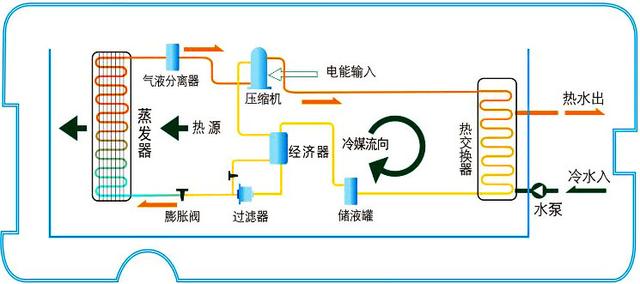
Air source heat pump: high efficiency, energy saving, strong adaptability
The air source heat pump uses air as a low heat source, drives the compressor and motor to do work through the input of electric energy, absorbs the heat in the air, and carries out heat exchange.
Advantages:
Wide range of application: Air source heat pump can be used in the temperature range of -7 to 40 ° C all weather, not affected by bad weather.
Low operating costs: Compared with gas, electricity and electrically assisted heating solar water heaters, air source heat pumps have the lowest annual costs and significant energy saving effects.
High safety performance: it will not produce any waste gas, emit toxic gases, there is no danger of leakage, safety and reliability.
Cons:
Slow heating speed: Because the air source is a dispersed energy source, the heating speed is relatively slow, and the thermal efficiency is not high.
Limited by the region: in the -10℃ or extremely low temperature environment, there is less heat energy in the air, and the work efficiency will be greatly reduced.
Water source heat pump: The use of water, efficient and stable
The water source heat pump uses surface water, groundwater, seawater, sewage, etc. as the low heat source, and realizes the transfer of low heat energy to high heat energy through a small amount of high power input.
Advantages:
High efficiency and energy saving: The water source heat pump uses the relatively stable characteristics of water temperature to ensure stable operation of the unit.
Strong environmental protection: whether it is cooling or heating, the water source heat pump unit can achieve no waste, no pollution emissions, and significant environmental benefits.
Small floor area: direct use of groundwater system, eliminating boiler room and auxiliary coal yard, oil storage room, cooling tower and other facilities, saving building space, small floor area.
Cons:
Water constraints: The need for adequate groundwater resources, vulnerable to seasonal water level drops, environmental protection measures and many other factors.
Recharge problem: well water recharge is difficult to implement, easy to cause the waste of groundwater resources and ground subsidence.
Water quality issues: Impurities and chemicals in groundwater can cause corrosion and clogging of units and pipes.
Ground source heat pump: stable and efficient, green environmental protection
Ground source heat pump to underground pipe or groundwater as a low-level heat source, through the water and ground energy (groundwater, soil or surface water) for cold and heat exchange, winter extraction of ground energy heating, summer release of indoor heat to the ground.
Advantages:
High efficiency and energy saving : ground source heat pump uses the constant temperature of underground soil to absorb heat from the ground in winter and release heat in summer. Compared with traditional air conditioning systems, the energy efficiency is higher and the operating cost is lower.
Safety environmental protection : ground source heat pump does not use coal, natural gas and other fossil fuels, does not produce waste gas, waste residue, friendly to the environment;
Long service life , low maintenance cost.
Cons:
High installation cost : the installation cost of ground source heat pump is high, especially in the case of burying holes, the cost will increase significantly;
Subject to regional restrictions : the installation and use of ground source heat pumps are affected by regional energy policies, fuel prices and other factors, especially in the plain area is cheaper, but in the mountainous and hilly areas need to recalculate whether it is worthwhile.
Conclusion
Whether it is ground source heat pump, water source heat pump, or air source heat pump, clean energy is used in operation, which can play a role in energy conservation and environmental protection to a certain extent. As for who has the advantage, different regions should choose suitable products in combination with different situations in order to truly achieve the purpose of reducing operating costs, energy saving and environmental protection.