The Sino-US trade war has resumed.
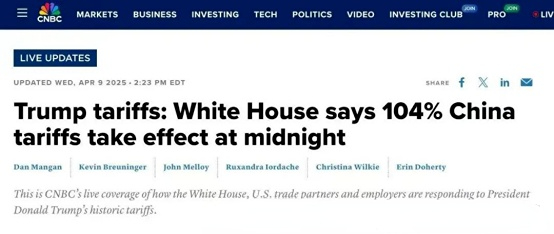
The US Customs and Border Protection further updated its tariff rules on April 8, announcing that the tariff rate on Chinese imports will increase from 34 percent to 84 percent from April 9, 2025, adding the previous tariffs to bring the total tariff rate to a staggering 104 percent.
China quickly retaliated, announcing on April 9 that it would sharply increase tariffs on some American imports to 84 percent from the original 34 percent in direct response.
The "tariff response" has put heavy pressure on the fishery industries of both countries. Exports of Chinese tilapia, ð« fish and prawns to the US have been blocked, and US salmon and other products are also facing difficulties in the Chinese market
In the face of this no-winner trade war, how should Chinese aquatic people break through?
The fisheries dilemma under the tariff war
"This is not a simple trade friction, but a precision strike" - on April 3, 2025, the Trump administration announced the implementation of "reciprocal tariffs" on the world's major trading partners, and since then the tariff rate has been increasing, even as high as 104%. The most direct and obvious effect of the tariff increase is undoubtedly a sharp rise in costs.
According to the U.S. Department of Agriculture, the United States exported more than $1 billion in fish and seafood to China in 2024. Most of these goods are processed in China and then exported to other countries.
High U.S. tariffs could affect this supply chain, triggering price volatility and supply disruptions.
In addition, the United States imports hundreds of thousands of tons of seafood to China each year, worth up to $1.5 billion, and the increase in tariffs has also led to increased costs.
These costs will ultimately be borne by American consumers - the Peterson Institute for International Economics estimates that American households will pay about $1,200 more a year.
For Chinese aquatic enterprises, the impact is more direct:
Top of the list are tilapia, ð« fish and prawns
Us importers are turning to alternative sources such as Vietnam and India
Higher prices for feed ingredients, such as US soymeal, have pushed up farming costs
Rising import costs for processing equipment, packaging materials and so on squeeze profits
"It's not about anger, it's about us." In the face of this competition of national strength, endurance and concentration, China's fishery industry must find a new way to survive.
One way to break the game: market diversification, internal and external development
"Enterprises should increase the development of the domestic market, diversify operations, and reduce the proportion of exports." Faced with the uncertainty of the US market, Chinese aquatic enterprises are actively adjusting their strategies:
Deepen the domestic market
The scale of domestic aquatic product consumption market continues to expand, and the overall annual growth rate rises.
Consumers have improved quality requirements, not only the pursuit of traditional fish and shrimp, but also the demand for specialty products and products is increasing.
Expand sales channels through supermarket cooperation and e-commerce platforms.
Hold food festivals, tasting meetings and other activities to enhance consumer awareness.
Explore emerging international markets
Eu market: The demand for high-quality aquatic products is large and stable, and Chinese perch, Mandarin fish and so on have been favored.
Asean market: Geographical location is close, economic development is fast, and Chinese shrimp products have accounted for a large share.
Strengthen technological exchanges and investment cooperation with ASEAN countries to achieve mutual benefit and win-win results.
Canada's experience is worth warning: 90% of the country's geoduck, crab and other exports to China, after China's counter-tariffs faced "catastrophe." This is yet another example of the risks of over-reliance on the single market.
The second way to break the game: industrial upgrading, increase added value
In order to remain invincible in the fierce competition, aquatic enterprises are promoting upgrades from multiple dimensions:
Quality improvement: strengthen the management of breeding links, strictly control the breeding environment; Adopt scientific farming methods to reduce drug use; Establish an ecological breeding base to simulate the natural ecological environment.
Technological innovation: the introduction of industrial recirculating aquaculture technology, the application of intelligent aquaculture equipment such as automatic feeding system, water quality monitoring sensors; We will increase investment in seed research and development to select and breed excellent varieties.
Brand building: Cultivate independent brands, improve the added value of products
In the short term, tariffs do weigh on aquatic exports. But in the long run, isn't this a transformational opportunity? China's aquatic industry is using technology and wisdom to walk out of a "winning road" of its own in the international market.
Although the tariff war is full of smoke, it also forces the industry to undergo deep changes. Through technology upgrading, market diversification and industrial transformation, Chinese aquatic people are fully capable of killing a new track of their own!