Because of its high efficiency, high yield, environmental protection and other characteristics, factory recirculating aquaculture has been widely respected, and has increasingly become an important development direction of China's aquaculture, but the cost control of recirculating aquaculture has also become an important issue in the industry.
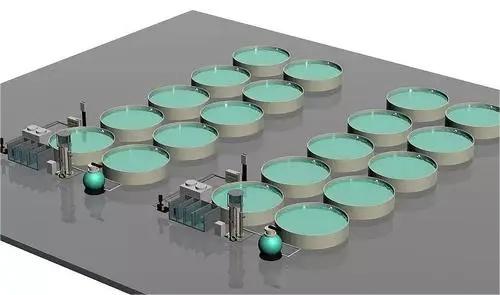
First of all, we need to know that a factory circulating water system is not simply a few farming buckets on the field, but a well-designed farming system.
This system includes water quality filtration monitoring, water temperature regulation, dissolved oxygen oxygenation, disinfection, feeding and other links, each link needs accurate technical support and scientific management, in order to reduce energy consumption and reduce costs in the design of circulating water system, so as to improve economic benefits.
There are many aspects to reduce consumption. Here are some key considerations and strategies:
01 Optimize system design and layout
The energy efficiency of the system is taken into account at the beginning of the design. Rational layout of pools, pipes, pumps, valves and other components to reduce fluid resistance and improve operating efficiency. Anticipate and plan for future expansion needs to ensure that the system remains efficient in the future.
For example, in the planning and design of the site, the location of the breeding tank should be defined first, and the rest of the system equipment should be built around the pool as far as possible to reduce the length and elbow of the water supply and drainage pipeline, and reduce the pipe resistance loss.
02 Select energy-efficient devices
Use high efficiency motor, variable frequency drive pump, energy saving valve and other high efficiency energy saving equipment. These devices reduce energy consumption during operation and improve the overall energy efficiency of the system.
03 Precise control and management
The energy management system is introduced to monitor and analyze the data of the whole circulating water system in real time.
Automatic adjustment of equipment operating parameters according to demand to ensure that the system is always in the best working condition.
Set up water quality testing equipment to monitor the pH value, turbidity, dissolved oxygen content and other data of circulating water, and maintain the appropriate quality of circulating water by adjusting the addition of appropriate drugs and purification.
04 Speed regulation and control of circulating pump
The working condition of circulating water pump in the primary should match with the actual condition to improve the operation efficiency of the water pump.
The speed regulating device is configured to adjust the speed of the circulating pump according to the change of the production process, so that the sending pressure and flow can meet the process requirements, and the pump can work in the efficient interval.
Avoid the use of regulating gate valves to consume energy to reduce the fluctuation of water pressure in the working series.

05 Throttle decompression
Throttle valves and pressure reducing valves are installed on the circulating water pipe to control water flow speed and pressure to reduce energy consumption and water flow resistance.
Throttle decompression control should be adjusted according to different production needs and environmental conditions to avoid the adverse effects of excessive decompression.
06 System integration and collaborative operation
As far as possible, the various subsystems are integrated into a unified control platform to achieve higher energy efficiency through collaborative operation.
For example, unified management in conjunction with building automation systems (BAS) or heating, ventilation and air conditioning (HVAC) systems.
07 Maintenance and maintenance
Regular inspection and maintenance of equipment to ensure the normal operation of equipment, reduce energy waste.
Replace worn parts in time to maintain the best performance of the equipment.
08 Training operation awareness
Conduct professional training and guidance for operators to ensure that they understand the operating principles and strategies of the system, improve the operational awareness and level of operators, and avoid unnecessary losses caused by improper operation.
Starting from the above aspects, a more efficient and energy-saving circulating water system is designed to reduce energy consumption, achieve effective cost control, and make factory circulating aquaculture truly become a sustainable development industry.