Recently, the Ministry of Agriculture and Rural Affairs released the "National Fishery Economic Statistical Bulletin 2024", comprehensively presenting the new trends in China's fishery economic development over the past year. Data shows that the national fishery economy has continued to grow steadily, with its industrial structure constantly optimized, making significant contributions to rural revitalization and food security.
The overall scale has steadily increased
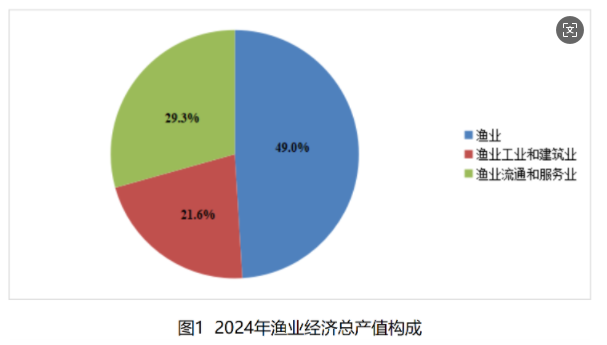
In 2024, the total output value of the national fishery economy was 3,417.229 billion yuan. Among them:
The output value of the fishery industry was 1,675.48 billion yuan
The output value of the fishery industry and the construction industry was 739.084 billion yuan
The output value of fishery circulation and service industry was 1,002.665 billion yuan
The proportion of the output value of the three industries is 49.0:21.6:29.3.
Fishery production remained stable
The output of aquatic products has reached a new high
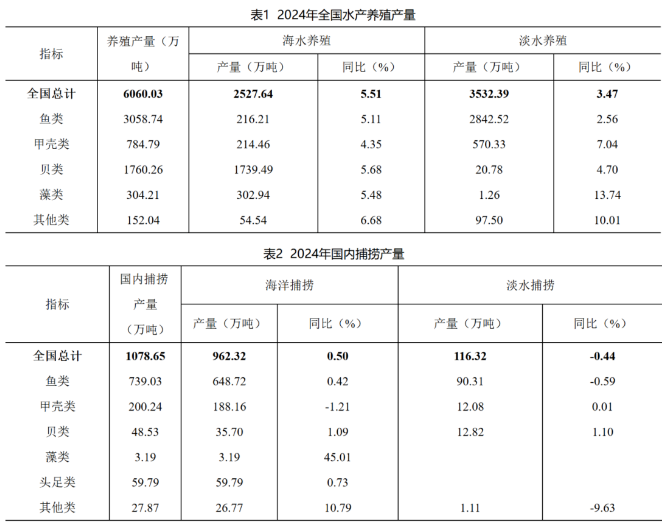
The total output of aquatic products across the country was 73.5759 million tons, up by 3.39% year-on-year. Among them:
The output of aquaculture was 60.6003 million tons (accounting for 82.4% of the total output, with a year-on-year growth of 4.31%)
The catch output was 12.9456 million tons (accounting for 17.6% of the total output, down 0.69% year-on-year)
The structure of aquaculture and fishing has been continuously optimized
The aquaculture industry continued to maintain its dominant position, with the output of Marine aquaculture reaching 37.0887 million tons, increasing by 3.45% year-on-year. The output of freshwater products was 36.4872 million tons, increasing by 3.34% year-on-year. The fishing industry continued to implement the policy of reducing volume and improving quality. The Marine catch output was 10.7865 million tons, basically the same as the previous year.
The area of aquaculture has declined
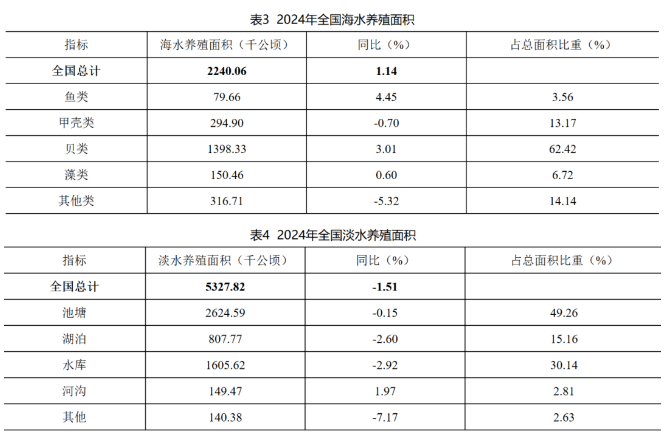
In 2024, the national aquaculture area was 7,567.88 thousand hectares, a year-on-year decrease of 0.74%.
Among them, the area of Marine aquaculture was 22,400,600 hectares, increasing by 1.14% year-on-year.
The freshwater aquaculture area was 5,327.82 thousand hectares, a year-on-year decrease of 1.51%.
The area ratio of Marine aquaculture to freshwater aquaculture is 29.6:70.4
The trade in the aquatic products market is active
The processing of aquatic products increased year-on-year
There are 9,581 aquatic product processing enterprises and 9,737 aquatic product cold storage facilities across the country. The total volume of processed aquatic products was 22.5376 million tons, up by 2.47% year-on-year.
Import and export trade grew steadily
The total volume of aquatic product imports and exports was 11.172 million tons, increasing by 5.79% year-on-year respectively. Among them:
The export volume was 4.2396 million tons, up 11.62% year-on-year. The export volume was 20.74 billion US dollars, increasing by 1.35% year-on-year
The import volume was 6.9324 million tons, increasing by 2.52% year-on-year. The import value was 23.097 billion US dollars, a year-on-year decrease of 2.85%
Fishery workers and their income
By the end of 2024, the fishing population was 15.8247 million, a decrease of 161,000 from the previous year, representing a year-on-year decline of 1.01%. Among the fishing population, the number of traditional fishermen was 4.8808 million, a decrease of 182,000 compared with the previous year, representing a year-on-year decline of 3.59%. The number of fishery workers was 11.7417 million, a decrease of 20,600 compared with the previous year, representing a year-on-year decline of 0.18%
Fishery disaster
In 2024, due to the fishery disaster, the output of aquatic products was lost by 481,500 tons, the affected aquaculture area was 2,674,800 hectares, and the direct economic loss was 15.024 billion yuan.
Development highlights and trends
Digital transformation is accelerating: Technologies such as the Internet of Things, big data, and artificial intelligence are widely applied in all aspects of fishery production, management, and sales.
Remarkable achievements have been made in green development: the promotion of technologies such as energy conservation and emission reduction, and recirculating aquaculture has been intensified, and the fishery ecological environment has continued to improve.
In-depth development of industrial integration: New business forms such as leisure fishery and fishery cultural creativity are flourishing, and the industrial chain is constantly extending.